
Commercial Power Cuts in York: Emergency Response & Business Continuity
A practical plan for protecting people, stock, data and trading continuity when a York workplace loses power or commercial breakers trip.
A practical plan for protecting people, stock, data and trading continuity when a York workplace loses power or commercial breakers trip.
Picture a busy York restaurant during evening service or an office handling customer systems when the lights and equipment suddenly go out. Rapid, orderly action matters, but speed must not come at the expense of electrical safety.
Commercial sites often have higher loads, three-phase equipment and more complex circuit routing than homes. A local breaker trip may point to an equipment fault, overload or wiring problem; a wider outage may sit with the network operator. This guide focuses on continuity and safe decisions, while our emergency commercial callout page explains how to request help.
Treat unexplained loss of power as a controlled incident. Do not open electrical equipment, remove covers or ask staff to force-reset breakers.
| Action | What to do | Why it matters |
|---|---|---|
| Protect people | Stop work safely, use maintained escape routes and account for staff, customers and contractors. | Reduces injury and evacuation risk. |
| Check the extent | From a safe position, note which areas are off and whether neighbours or street lighting are affected. | Helps distinguish site faults from network outages. |
| Look and listen | Report burning smells, smoke, buzzing, heat, water ingress or damaged equipment. Do not touch it. | Gives the electrician useful risk information. |
| Leave breakers alone | Never force or repeatedly reset a breaker. One reset should only be considered under an authorised site procedure where no warning signs exist. | Repeated operation can re-energise a fault. |
| Protect operations | Follow approved shutdown plans for cooking, refrigeration, IT, machinery and access systems. | Limits secondary damage and data loss. |
Smoke, fire or immediate danger: evacuate, call 999 and do not re-enter. For an unexplained site fault, call Nfinnerty Electrical on 01904 202234. No response time is guaranteed; attendance depends on location, access and current demand.
Name the incident lead, facilities contact, IT lead, landlord or managing agent, insurer contact and customer communications owner.
Identify refrigeration, alarms, medical or welfare equipment, servers, pumps and safe access systems. Do not connect ad hoc generators or extension leads.
Keep refrigerator and freezer doors closed, record temperatures where required, and follow documented IT shutdown and recovery procedures.
Do not resume all loads at once. Confirm what has been tested, what remains isolated and who has authorised restart.
For planned resilience reviews, Nfinnerty provides broader commercial electrical support for York workplaces.
The attending electrician's first job is to make the installation safe. The sequence will depend on symptoms and access, but typically includes:
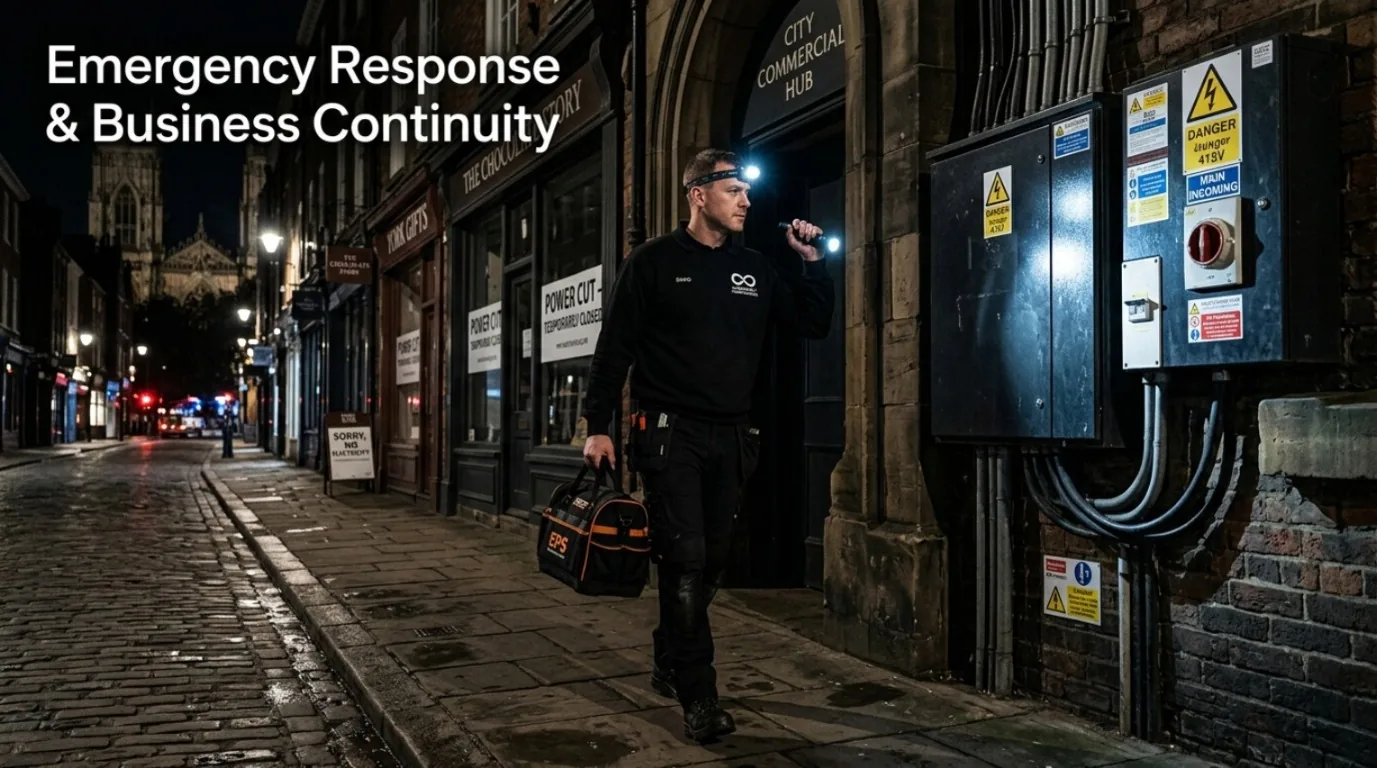
For household and general emergency warning signs, read our related York emergency electrician guide.
Keep distribution board schedules, test records, isolation points and landlord contacts available to authorised staff.
New kitchen equipment, machinery, air conditioning or IT can change demand and circuit use. Arrange assessment before expansion.
Maintain emergency lighting, UPS units, generators and changeover equipment to manufacturer and competent-person guidance.
Decide who updates staff, customers, suppliers and delivery partners if trading must pause or move.
No. A breaker that trips again may be responding to a continuing fault or overload. Do not force or repeatedly reset it; keep people away and arrange competent diagnosis.
Share the site address, affected areas, when the outage began, any smell, heat, noise or water ingress, what was running beforehand, and whether neighbouring properties still have power.
Not always. The electrician first makes the situation safe and identifies the cause. Parts, network faults, access restrictions or extensive damage can require a planned follow-up repair.
Keep an up-to-date contact tree, identify critical loads, document safe shutdown steps, maintain emergency lighting and backup systems, and review the installation when equipment or operating patterns change.
For independent regulatory and safety context, consult the current official guidance below. Requirements can change, and advice for a specific installation should be based on an on-site assessment.