Electric Vehicle Charger Installation · York & Yorkshire
Can a Normal Electrician Install an EV Charger?
With electric vehicle ownership rising fast across Yorkshire, one of the most common questions we hear is whether any electrician can fit a home charger — or whether special authorisation is required. The short answer matters for your safety, your grant eligibility, and your legal compliance.
Electric vehicles are now a mainstream choice for Yorkshire drivers. As home charging becomes the norm rather than the exception, the demand for qualified EV chargepoint installers has grown rapidly — and so has the risk of poor-quality work carried out by tradespeople who lack the right authorisation. This guide sets out exactly what qualifications are required, what the UK government rules say, and what electrical safety considerations apply when charging an electric vehicle at home.
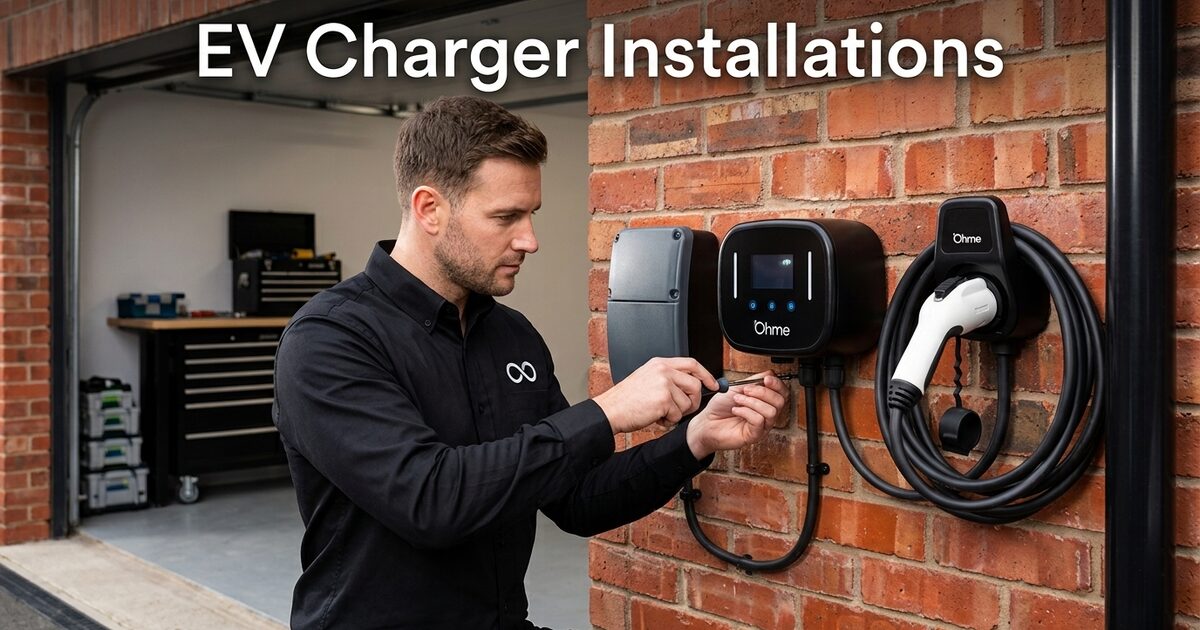
A professionally installed home EV charger with the correct dedicated circuit, protection and certification.
Table of Contents
The Direct Answer: Can Any Electrician Install an EV Charger?
Technically, a qualified electrician can carry out the electrical wiring work involved in an EV charger installation. However, to legally sign off the work, claim a government grant, and comply with current UK regulations, the installer must hold OZEV (Office for Zero Emission Vehicles) authorisation through an approved scheme such as NAPIT or NICEIC.
The practical rule: An OZEV-authorised installer is a one-stop solution — they carry out the work, certify it under Part P Building Regulations, and process grant applications. An ordinary electrician without OZEV authorisation cannot certify EV charger installations or access grants on your behalf.
This distinction matters considerably for York and Yorkshire homeowners. Using an unauthorised installer may mean you:
Lose access to EV Chargepoint Grant support
Cannot obtain the required Building Regulations certificate
Void your home insurance if a fault occurs
Face issues when selling your property due to missing certification
Risk the installation being flagged as non-compliant
OZEV-authorised installer
Can install, certify, and apply for grants. One visit, fully compliant, grant-eligible, insured.
Standard electrician only
Can carry out wiring but cannot certify EV charger work or access grants without OZEV authorisation.
Qualifications an EV Charger Installer Needs in the UK
The minimum requirements for a legitimate electric vehicle charger installer in the UK go beyond standard electrical qualifications. Here is what a fully authorised EV installer must hold:
NVQ Level 3 (or equivalent)
A core electrotechnical qualification — typically NVQ Level 3 in Electrotechnical Services or the equivalent City & Guilds 2365.
18th Edition (BS 7671)
Current knowledge of the IET Wiring Regulations, updated for the 2022 amendment. All domestic EV installations must comply.
OZEV authorisation
Registered through an OZEV-approved body (NAPIT, NICEIC, or similar) to install EV chargepoints and process grants.
Part P competent person scheme
Membership of a government-approved competent person scheme allowing self-certification of notifiable electrical work in domestic premises.
EV manufacturer training
Brand-specific training from charger manufacturers such as Andersen, Ohme, Zappi or Easee — required for warranty and recommended practice.
Public liability insurance
Appropriate liability cover for domestic electrical installation work, typically £2m or more for residential projects.
NFinnerty Electrical holds NAPIT registration, OZEV authorisation, and is an approved installer for leading charger brands. You can verify our registration status directly with NAPIT.
EV Charger Installation Requirements Under UK Gov Rules
The UK government sets out clear technical and procedural requirements for electric vehicle charger installations in domestic properties. Key obligations include:
UK requirements for a compliant home EV charger installation
Requirement
Detail
BS 7671 compliance
All wiring must comply with the IET Wiring Regulations 18th Edition (Amendment 2, 2022), including the EV-specific requirements in Section 722.
Dedicated circuit
A dedicated circuit from the consumer unit to the charger is required — the charger must not share a circuit with other loads.
RCD and overcurrent protection
An appropriate RCD (Type A or Type B depending on charger specification) and overcurrent device must be fitted in the consumer unit.
Part P notification
Installing a new circuit is notifiable work under Part P of the Building Regulations. An OZEV-authorised installer self-certifies; otherwise a Building Control application is required.
Smart charger requirement
For grant eligibility, the charger must be OZEV-compliant and smart-capable (app-controlled scheduling, data logging). Basic non-smart chargers are not grant-eligible.
Earth bonding
Where an earthed metal water pipe or gas pipe is accessible within 1 m of the charger, supplementary equipotential bonding may be required under BS 7671.
Consumer unit capacity
The existing consumer unit must have the spare capacity to accommodate the additional load. Where it does not, an upgrade will be required before charger installation.
The government's EV Chargepoint Grant scheme is administered through OZEV and requires applications to be made by an approved installer on your behalf. Attempting to self-install or use an unauthorised installer means you cannot access this route.
For the most current grant conditions and eligibility criteria, see the official GOV.UK guidance on EV grants. Terms change regularly and your installer should confirm live eligibility before installation.
Electrical Safety Advice for Electric Vehicles at Home
Charging an electric vehicle at home is safe when the installation has been carried out correctly by a qualified electrician. However, there are important safety points every Yorkshire EV owner should understand:
Never use a standard 3-pin socket for regular charging
A standard 13A household socket is only suitable for occasional, low-rate ‘granny charging’ and is not designed for the sustained current draw of overnight EV charging. Overheating and fire risk are genuine concerns with prolonged socket use.
Check your cable regularly
Inspect the charging cable for damage, fraying, or signs of heat before each charge. Never charge with a damaged cable, and store it away from water and sharp edges.
Ensure your consumer unit can handle the load
A 7kW charger draws around 32A continuously. If your consumer unit is old or already loaded, adding an EV charger without assessment is a potential overload risk. A qualified assessment is essential.
Use smart scheduling to avoid peak-load times
Smart chargers allow overnight scheduling so your EV charges when the grid and your domestic circuits are under less strain. This also reduces your electricity cost significantly.
RCD protection is non-negotiable
All home EV charger circuits must include RCD protection. A Type A RCD is the minimum for most AC chargers; some charger specifications require a Type B device. Your installer will specify the correct protection.
Outdoor installations need weatherproof protection
External charger units must be rated to at least IP44, with cable entries sealed and the unit positioned to avoid direct water ingress. Cable runs outside require appropriate weatherproof conduit or armoured cable.
In an electrical emergency — if you smell burning from your charger, see scorch marks, or your RCD trips repeatedly during charging — stop charging immediately and call a qualified electrician. Do not attempt to investigate the fault yourself.
How to Find a Qualified EV Chargepoint Installer Near You
When searching for an EV electrician in York or anywhere in Yorkshire, use these checks to confirm you are dealing with a properly authorised installer:
1. Verify OZEV authorisation
Ask the installer which OZEV-approved body they are registered with (NAPIT, NICEIC, etc.) and check directly with that body. NAPIT and NICEIC both have public search tools.
2. Check their Part P scheme registration
They should be able to self-certify new circuits under a government-approved competent person scheme. Ask for the scheme name and their membership number.
3. Ask for a written fixed quote
A reputable EV installer provides a written quote covering charger hardware, labour, materials, and any consumer unit work. Beware of verbal-only pricing.
4. Check verifiable reviews
Look for independently verified reviews on Google or Checkatrade — not just testimonials on the installer's own website. Volume and recency of reviews matters.
5. Confirm grant handling
If you may be eligible for a grant, confirm the installer will handle the application process on your behalf and not just pass you a form to complete yourself.
6. Ask about post-install support
A quality installer will support you after installation — including app setup, smart tariff advice, and warranty queries. Check what is included after the work is done.
NFinnerty Electrical is an OZEV-authorised, NAPIT-registered EV chargepoint installer serving York and surrounding areas. See our EV charger installation service page for more details.
Government Grants & Free EV Charger Installation Routes
A common search question is whether electric car charger home installation is free in the UK. The honest answer is: not entirely, but meaningful financial support is available.
EV Chargepoint Grant
Government-backed grant support is available through the EV Chargepoint Grant scheme for eligible homeowners, tenants (with landlord permission), and leaseholders. The grant reduces the upfront cost of a smart charger installation. Current amounts and qualifying criteria should be confirmed at the time of application — terms change.
0% VAT on domestic installs
Domestic EV charger installations currently attract 0% VAT, reducing the effective cost by 20% compared to a business installation. No application is required — this is applied automatically by your installer at point of invoice.
Yorkshire council schemes
City of York Council and other Yorkshire local authorities periodically operate additional top-up funding for EV charger installations, particularly for lower-income households or specific council tax bands. These schemes open and close; ask your installer about currently active local incentives.
Energy supplier cashback
Several energy suppliers offer cashback incentives when you adopt a smart EV tariff alongside your charger installation. Octopus Energy, British Gas, Ovo Energy, and EDF all operate EV-specific tariffs with off-peak rates and potential cashback. Savings depend on your mileage and tariff.
NFinnerty’s EV Charger Installation Process in York
As an OZEV-authorised chargepoint installer based in York, NFinnerty Electrical handles every stage of your EV charger installation — from initial survey through to commissioning and post-install support.
Step 1: Free remote survey
Send us photos of your driveway, meter, and consumer unit. We assess feasibility, identify any consumer unit upgrades required, and confirm grant eligibility — all before a site visit.
Step 2: Fixed written quote
You receive a detailed, fixed-price quote covering charger hardware, installation labour, materials, and any preparatory work. No hidden extras.
Step 3: Grant application
Where you are eligible, we handle the EV Chargepoint Grant application and any local council top-up process on your behalf before the installation date.
Step 4: Installation day
A dedicated NFinnerty electrician installs the charger, runs the dedicated circuit, fits appropriate RCD protection, and commissions the unit. Most standard installs are completed within half a day.
Step 5: Testing and certification
We test the complete installation to BS 7671 standard, issue the electrical installation certificate, and provide the Part P Building Regulations certificate for your records.
Step 6: App setup and handover
We connect your smart charger to the app, configure scheduled charging, and walk you through the controls. You also receive guidance on EV tariff switching to maximise running cost savings.
Why EV Charging Stations Will Always Need Electricians
With the UK’s rapid adoption of electric vehicles, one fact is clear: the demand for qualified electricians specialising in EV chargepoint installation is growing, not shrinking. Here is why skilled electricians are central to the EV transition — and will remain so:
Consumer unit assessments and upgrades
Millions of UK homes have ageing consumer units that cannot safely accommodate a 7kW EV charger without an upgrade. Only a qualified electrician can correctly assess, specify, and carry out that upgrade.
Complex cable routes in older properties
Yorkshire has a large stock of Victorian and Edwardian homes where standard EV charger cable routes are rarely straightforward. Timber-framed walls, stone construction, and cellars all require a skilled hand.
Safety certification and compliance
Every EV charger installation is notifiable electrical work under Building Regulations. Certified electricians provide the legal paper trail that protects homeowners, landlords, and tenants.
Fault diagnosis and maintenance
Charger faults — ranging from nuisance tripping to communication errors — require electrical diagnosis that goes beyond app-level troubleshooting. A registered electrician resolves issues that manufacturers cannot fix remotely.
Solar and battery integration
Smart home energy systems that combine EV charging with solar PV and battery storage require complex installation and commissioning that is beyond any non-electrical trade.
Future-proofing for V2H and V2G
Vehicle-to-home and vehicle-to-grid technologies are arriving. Preparing domestic electrical infrastructure for bidirectional charging requires forward-thinking, expert design that only a specialist electrician can deliver.
FAQs: Electric Vehicle Charger Installation
Can a normal electrician install an EV charger?
Not without the right authorisation. A standard qualified electrician can carry out the wiring, but in the UK they must hold OZEV authorisation (through NAPIT, NICEIC, or a similar body) to certify the installation, access the EV Chargepoint Grant, and self-certify under Part P Building Regulations. Without OZEV authorisation, a separate Building Control notification is required and grant access is lost.
What qualifications does an EV charger installer need?
An EV charger installer needs: a relevant electrical qualification (NVQ Level 3 or equivalent), current 18th Edition BS 7671 wiring regulations knowledge, OZEV authorisation through an approved body, Part P competent person scheme registration, and ideally manufacturer training for the specific charger brand being installed.
Is electric car charger home installation free in the UK?
Not entirely, but costs can be substantially reduced. The EV Chargepoint Grant provides support for eligible applicants, domestic installations benefit from 0% VAT, and local council top-ups may be available in Yorkshire. Energy supplier cashback and smart tariff savings further reduce the net cost over time. Your installer should walk you through all available support before work begins.
What are the EV charger installation requirements under UK gov rules?
Key requirements include: compliance with BS 7671 Section 722 (electric vehicle charging installations); a dedicated circuit from the consumer unit; appropriate RCD and overcurrent protection; Part P Building Regulations notification (or self-certification by a competent person scheme member); and a smart, OZEV-compliant charger for grant eligibility. A full inspection and installation certificate must be provided.
How do I find a qualified EV chargepoint installer near me in York?
Check that your installer is registered with NAPIT or NICEIC and holds OZEV authorisation. Both NAPIT and NICEIC have public directories. You can also search the government’s OZEV-approved installer database. NFinnerty Electrical is an OZEV-authorised, NAPIT-registered EV chargepoint installer serving York and Yorkshire — call us on 01904 202234 for a free quote.
Do I need to upgrade my consumer unit before getting an EV charger?
Not always, but it depends on your current consumer unit’s age and available capacity. Many older fuse boards cannot safely accommodate a 7kW dedicated EV charger circuit without an upgrade. A pre-installation survey — which NFinnerty provides free of charge — will identify whether an upgrade is needed and include this in your quote.
Is it safe to charge an electric vehicle at home?
Yes — when the installation has been carried out correctly by a qualified, OZEV-authorised electrician. The main risks arise from using a standard 3-pin socket for regular charging, using damaged cables, or having an installation that has not been properly assessed and certificated. A professionally installed dedicated 7kW home charger is the safest and most efficient way to charge your electric vehicle.
Conclusion: Use an OZEV-Authorised Installer in York
The answer to “can a normal electrician install an EV charger?” is clear: not without OZEV authorisation. For York and Yorkshire homeowners, using a fully authorised chargepoint installer means your installation is compliant, certified, grant-eligible, and safe — with no risk of missing out on available government support or facing problems when you sell your property.
NFinnerty Electrical is an OZEV-authorised, NAPIT-registered EV chargepoint installer with over 15 years of experience serving York and surrounding areas. We handle everything from initial survey and grant applications to installation, certification, and post-install support.
NFinnerty: OZEV Authorized Installer | NAPIT Registered | 15+ Years York Experience | 1,500+ EV Chargers Installed
Keywords: electric vehicle charger installation York, can a normal electrician install an EV charger, EV chargepoint installer Yorkshire, OZEV authorised installer York, electric car charger home installation UK, EV charger installation requirements UK gov, EV electrician near me, electrical safety advice electric vehicles, free electric car charger home installation UK.
Official guidance and sources
For independent regulatory and safety context, consult the current official guidance below. Requirements can change, and advice for a specific installation should be based on an on-site assessment.