
HMO & Commercial EICR Rules in York: What Landlords Must Know in 2026
The practical 2026 guide to inspection cycles, mandatory checks, remedial deadlines, and compliance records for York property managers.
The practical 2026 guide to inspection cycles, mandatory checks, remedial deadlines, and compliance records for York property managers.
If you manage a House in Multiple Occupation (HMO) or commercial property in York, you already know that compliance isn't just a box-ticking exercise. It is about keeping your tenants, visitors, employees, and business safe.
In 2026, the rules and standards around Electrical Installation Condition Reports (EICRs) remain stringent. Staying ahead of the inspection date is the best way to reduce enforcement risk, disruption, and problems with insurance evidence. To arrange an inspection, visit our EICR certificates service page.
HMO and commercial dutyholders must arrange inspection and testing at the interval stated on the previous report and according to the property's use and risk. Five years is a common maximum interval, while a change of tenancy or occupancy should trigger a review of the installation and its records.
The exact legal route differs between private rented homes, licensed HMOs, and commercial premises, so landlords should also check their licence conditions, lease obligations, insurer requirements, and fire-risk assessment.
A qualified person must inspect the installation at least every five years, or sooner where the report requires it.
Licence conditions and local authority requirements may add duties beyond the general private rented sector rules.
Dutyholders must maintain electrical systems so they remain safe; the inspection interval is set by risk and competent advice.
Review the current EICR, visible damage, alterations, and due date before a new tenant or occupier takes possession.
Do not assume one interval fits every property. Follow the shorter period where the report, licence, risk assessment, or insurer requires more frequent inspection.
During an inspection, an accredited electrician tests the fixed wiring, consumer units, protective devices, and built-in electrical fixtures to determine whether the installation is safe for continued use.
| Inspection area | What the electrician looks for | Primary risk |
|---|---|---|
| Circuits and equipment | Overloading, heat damage, and unsuitable protective devices | Fire |
| Accessible wiring and accessories | Damage, deterioration, and exposed live parts | Electric shock |
| Previous alterations | Defective work, unsafe extensions, and improper DIY fixes | Fault or injury |
| Earthing and bonding | Missing, damaged, or inadequate protective conductors | Shock under fault conditions |
Plan access to consumer units, distribution boards, sockets, and representative circuits before the appointment. For occupied HMOs or trading premises, coordinate access early to reduce disruption.
If the property does not receive a satisfactory report, the EICR identifies each observation with a classification code. The code helps the dutyholder understand the level of risk and the next action.
Immediate action is required to remove the danger or isolate the affected part of the installation.
Urgent remedial action is needed. A report containing a C2 is unsatisfactory until the issue is resolved.
The installation may still be satisfactory, but an improvement is recommended to raise safety or align with current practice.
More investigation is needed without delay because the inspection could not determine whether a safety problem exists.
For properties covered by the Electrical Safety Standards in the Private Rented Sector (England) Regulations, C1, C2, and FI issues must be addressed within 28 days or sooner where the report states a shorter period. Supply written confirmation to the tenant and local authority as required. Commercial dutyholders should act to the risk and the competent person's stated timeframe.
At NFinnerty Electrical, all inspection, testing, and subsequent remedial work is completed with reference to BS 7671 and current industry guidance. This provides a consistent technical basis for the report and the work required to close out defects.
Use an electrician with the qualifications, experience, and test equipment appropriate to the property and installation.
Observations should explain the defect, its classification, and the action needed rather than relying on a code alone.
Repairs should be tested and documented so the property file shows how each unsatisfactory observation was resolved.
Standards evolve, so use the edition and amendments in force when the inspection or installation work is carried out.
Read the IET Codes and Guidance for authoritative resources on safe and compliant electrical installations.
A completed inspection is only part of compliance. Keep a clear, retrievable record for every HMO or commercial site so you can answer tenant, insurer, managing agent, or local authority queries promptly.
Retain the signed report, inspection date, next due date, and complete schedule of test results.
File invoices, certificates, photographs, and written confirmation that C1, C2, or FI items were resolved.
Keep dated proof of reports supplied and all reasonable attempts to arrange access with tenants or occupiers.
Set reminders well ahead of the earliest date shown in the report, licence conditions, or risk assessment.
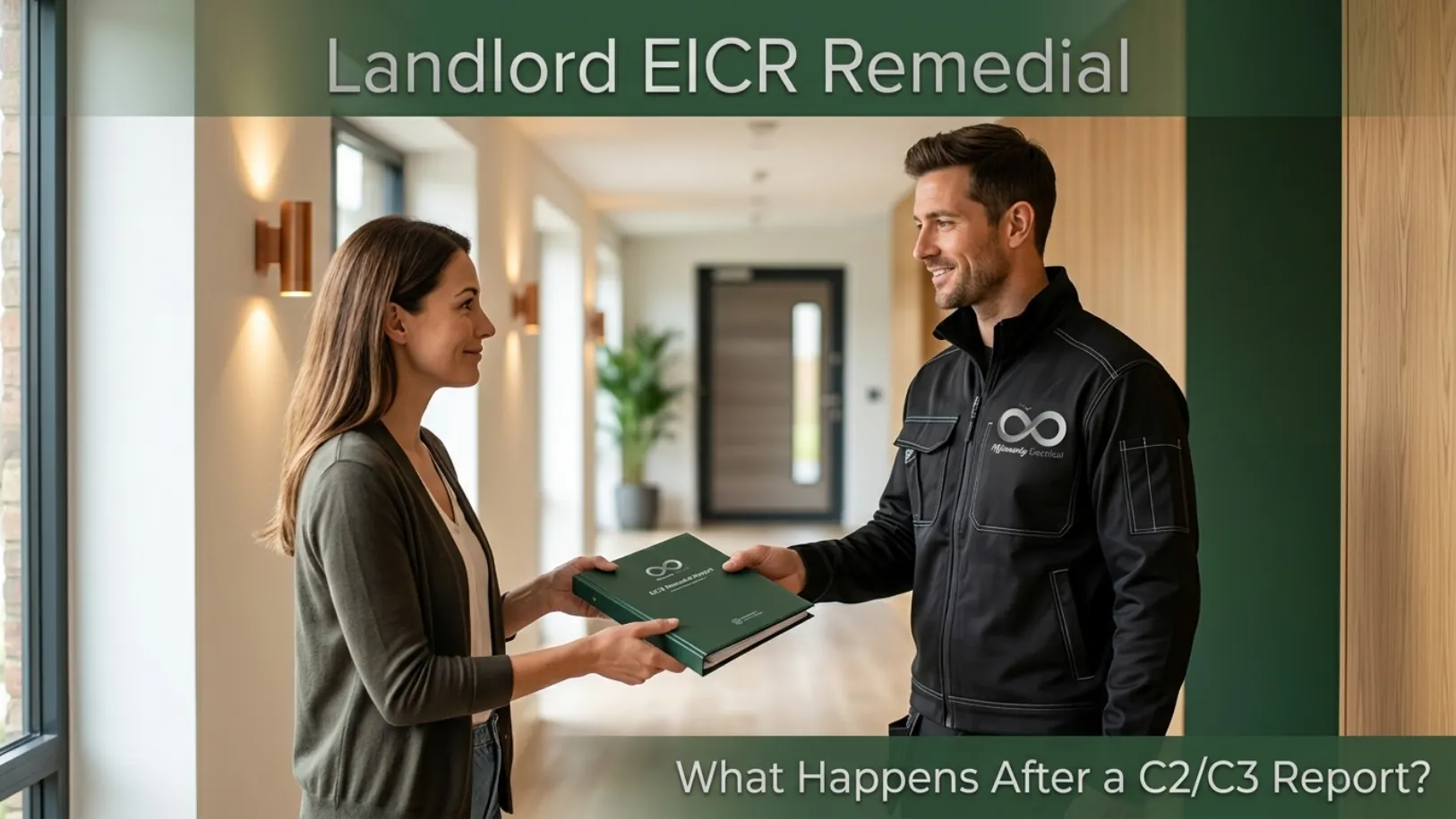
We support single-property landlords, HMO operators, letting agents, and commercial site managers with planned inspection and follow-on remedial work across York.
Access and isolation can be planned to minimise disruption to tenants, employees, customers, and essential services.
Inspection findings can be followed by quoted remedial work, testing, and the records needed to close out the report.
Build these steps into each property's compliance calendar rather than waiting for an expiry date or a request for evidence.
Check the tenancy type, HMO licence, lease, insurer conditions, risk assessments, and previous report.
Allow time for access planning, testing, quotations, and any remedial work before the compliance deadline.
Act immediately on C1 findings and urgently on C2 or FI findings, following any shorter period stated in the report.
Retain the EICR and remedial confirmation, then provide copies to tenants or authorities within the applicable timeframe.
For a private rented HMO in England, electrical installations must generally be inspected at intervals of no more than five years, or sooner where the report or licence requires it.
Not under one universal five-year rule. The appropriate interval depends on the installation, use, risk, previous report, lease, insurer, and dutyholder obligations. Five years is common, but a competent person may specify a shorter interval.
A report containing C1, C2, or FI observations is unsatisfactory. A C3 is an improvement recommendation and does not by itself make the report unsatisfactory.
Under England's private rented sector regulations, required work must be completed within 28 days or sooner if the report states a shorter period. A C1 danger should be made safe immediately.
A valid report does not automatically expire when a tenant changes, but the new tenant must receive a copy and the property should be checked for damage or alterations before occupation.
Yes. We can inspect the installation, explain the report, quote for remedial work, and provide the appropriate completion records.
Speak to our team about an HMO, commercial premises, or managed property portfolio in York.
Keywords: HMO EICR York, commercial EICR York, landlord electrical compliance, EICR remedial works, BS 7671 York.
For independent regulatory and safety context, consult the current official guidance below. Requirements can change, and advice for a specific installation should be based on an on-site assessment.